
Indigenous Women Are Reshaping the Future of Energy
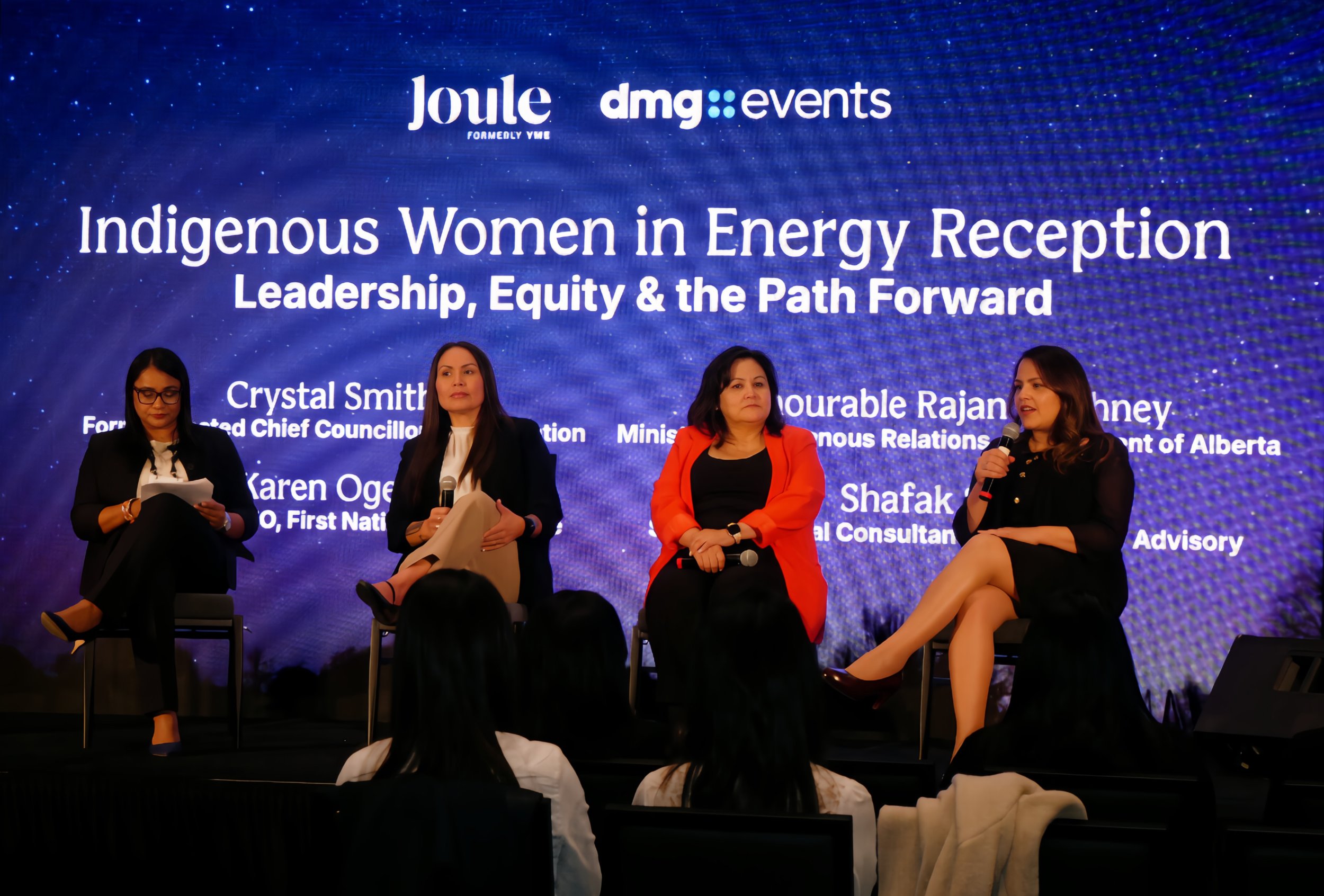
📸 Ankita Singh Photography
At Global Energy Show Canada, Joule brought together an extraordinary group of leaders for an evening conversation on Indigenous women in energy leadership, equity, and the path forward.
What emerged was far more than a discussion about representation. It was a candid conversation about trust, economic reconciliation, community well-being, and what responsible energy development looks like when Indigenous women are helping shape the decisions.
The evening opened with remarks from Alberta Minister of Indigenous Relations, Rajan Sawhney, who highlighted the growing role Indigenous communities are playing as partners, workers, and owners in major energy projects. She spoke about the importance of creating pathways into skilled trades and ensuring Indigenous women and youth are positioned to participate in the opportunities being created across Canada’s energy sector.
But her message went beyond workforce participation.
As major projects move forward across Canada, she emphasized that safety, accountability, and community well-being must be built into project design from the beginning—not treated as afterthoughts. Indigenous women, she noted, are helping lead those conversations, bringing forward perspectives rooted in lived experience, long-term thinking, and community priorities.
That theme continued throughout the fireside conversation featuring Crystal Smith, former Chief Councillor of the Haisla Nation; Karen Ogen, President and CEO of the First Nations LNG Alliance; Minister Rajan Sawhney; and moderator Shafak Sajid, Senior Principal Consultant at Neighborly Advisory (& a 2022 YWE Award Winner).
Early in the conversation, Shafak helped frame one of the central tensions of the evening: many Indigenous cultures have long-standing matriarchal or matrilineal leadership traditions, while the energy sector has historically been, and often continues to be, male dominated.
That framing created space for a deeper discussion about how Indigenous women’s leadership can shift not only who is at the table, but the kinds of questions being asked once decisions are being made.
Leadership Through a Different Lens
One of the first questions explored how Indigenous women’s leadership is influencing decision-making in a sector that has traditionally been male dominated.
For Crystal Smith, the answer lies in a different way of measuring success.
She described how many Indigenous communities approach leadership through a holistic lens - considering not only financial outcomes, but also the impacts on land, air, culture, families, future generations, and community well-being.
Rather than focusing solely on quarterly performance, Indigenous leaders often ask broader questions:
How are people doing?
Are communities thriving?
What will the impacts be seven generations from now?
Success, she shared, is not only about economic indicators. It is seeing community members access education, buy homes, travel, return home, and become role models for the next generation.
Karen Ogen reflected on her own journey from social worker to elected chief and eventually one of Canada’s leading voices on Indigenous participation in LNG development.
She spoke about coming from a matrilineal community where women’s leadership is not new. In her words, women have long held leadership roles within community governance and cultural systems. What is changing today is not the presence of Indigenous women leaders, but the opportunity to influence decisions at the scale of major energy development.
Economic Reconciliation in Practice
Economic reconciliation was one of the strongest themes of the evening.
The panel challenged attendees to think more critically about the growing use of the term. While “economic reconciliation” has become increasingly common across industry and government conversations, speakers emphasized that it must represent more than a buzzword.
Meaningful economic reconciliation is not simply consultation, procurement targets, or public commitments. It is about creating pathways for Indigenous communities to participate in decision-making, build capacity, access capital, develop businesses, and increasingly move into positions of ownership.
For Karen Ogen, economic reconciliation is about creating opportunities that help communities move from managing poverty to managing prosperity.
She spoke candidly about growing up in a community that watched transmission lines, railways, highways, and pipelines pass through traditional territory while community members continued to experience poverty and limited opportunity. Meaningful participation, she explained, requires more than consultation. It requires communities having the resources, capacity, and ability to participate in decisions and benefit from development occurring on their lands.
Karen also emphasized the importance of ensuring smaller Nations are not left behind. Many communities, she explained, do not have the same capacity, resources, or technical support to participate fully in major project conversations. Meaningful reconciliation requires more than inviting communities to the table; it requires making sure they have the information, funding, and capacity to participate in decisions that affect their lands and futures.
For Crystal Smith, economic reconciliation becomes tangible when community members can access opportunities many Canadians take for granted: education, home ownership, business ownership, and economic independence.
She described the pride of seeing Haisla Nation members qualify for mortgages, pursue education, build businesses, return home, and create new opportunities for future generations.
The conversation also highlighted Cedar LNG, the world’s first majority Indigenous-owned LNG export project, as a powerful example of what partnership can look like when Indigenous communities move beyond being stakeholders and become owners.
Rather than being presented with a completed project and asked for feedback, Indigenous leadership helped shape key decisions from the beginning including governance, location, technology choices, and project design.
Crystal offered one of the clearest examples of what that shift can look like in practice. In reflecting on LNG Canada and Cedar LNG, she described the difference between being treated as a regular stakeholder and being treated as a landowner.
That distinction matters. It changes the relationship, the decision-making process, and the level of respect built into the project from the beginning.
Instead of asking communities to react to development, the process invited communities to help define it.
Safety, Accountability, and Responsible Development
While economic participation and ownership were central themes throughout the discussion, panelists also emphasized that responsible development must include community well-being.
In her opening remarks, Minister Sawhney spoke about the importance of considering the impacts that major projects can have on nearby communities, particularly where temporary workforces and large work camps are involved. Drawing on discussions with Indigenous leaders and partners across Canada, she noted that safety cannot be treated as a secondary consideration. It must be incorporated into project planning, design, and operations from the outset.
The discussion also reflected broader national conversations around community safety and the ongoing work related to MMIWG2S+ (Missing and Murdered Indigenous Women, Girls, and Two-Spirit Plus people). While these topics were not the primary focus of the evening, they serve as an important reminder that reconciliation extends beyond economics alone.
Meaningful participation requires creating conditions where Indigenous people can participate safely, where communities feel supported, and where development contributes to long-term well-being alongside economic opportunity.
Relationships Before Projects
If there was one message that resonated throughout the evening, it was that relationships must come before projects.
Minister Sawhney challenged industry to move beyond assumptions and stereotypes. Communities are not all the same, and meaningful engagement cannot begin once decisions have already been made. Building trust requires showing up, spending time in communities, listening to concerns, understanding priorities, and developing relationships long before project approvals are sought.
Karen Ogen captured one of the defining themes of the evening in a simple but powerful statement:
“Projects move at the pace of trust.”
The quote reflected a broader conversation about what meaningful engagement looks like in practice. Trust cannot be built through a single consultation meeting or a transactional approach to community engagement. It is developed over time through relationships, presence, transparency, and a willingness to listen.
Throughout the discussion, panelists emphasized that communities want to be engaged early, have the capacity to participate in decision-making, and be treated as partners rather than stakeholders. When trust exists, projects move forward more effectively. When it does not, progress becomes far more difficult.
Shafak offered another important reframing for industry. Too often, Indigenous engagement is viewed through the lens of project risk. But as she reflected, the sector needs to move away from seeing Indigenous participation as risk and begin seeing it as trust and opportunity.
That mindset shift is essential if industry wants to build momentum around meaningful economic partnerships.
The conversation challenged a common industry mindset that views Indigenous participation as something to be managed. Instead, panelists argued that Indigenous leadership and early engagement should be viewed as an opportunity to create better projects, stronger partnerships, and more sustainable outcomes for everyone involved.
The Human Side of Leadership
As the conversation shifted toward leadership journeys, the discussion became deeply personal.
Karen shared her experience as the first member of her family to earn a university degree, overcoming significant obstacles and self-doubt along the way.
Her advice to young women was simple but powerful:
Believe in yourself.
Sometimes someone else believes in you before you believe in yourself. But eventually, you must recognize your own potential and have the courage to pursue it.
Minister Sawhney reflected on finding her voice as a young woman and person of colour in the energy industry. Often the only woman in the room, she learned to trust her instincts and speak up, even when it felt uncomfortable.
The lesson she would share with her younger self?
Don’t be afraid.
Measure the risk, understand the consequences, and then move forward with confidence.
Crystal Smith spoke movingly about how her daughters and grandson became her motivation through some of the most difficult leadership moments of her career. Her grandson, she shared, gave her a renewed sense of purpose and a deeper commitment to creating a future where the next generation has the supports, resources, and opportunities they need to thrive.
Leadership, she explained, is ultimately about creating better futures for the generations that follow.
Those moments of vulnerability transformed the conversation from a discussion about energy projects into a discussion about people, purpose, and legacy.
Looking Forward
While the discussion touched on leadership, economic reconciliation, ownership, community well-being, and responsible development, a common thread connected every topic: trust.
As Karen Ogen reminded the audience, “Projects move at the pace of trust.”
Whether building relationships with communities, creating pathways to ownership, or designing projects that reflect local priorities, the panel made it clear that the strongest outcomes emerge when trust is built first.
Their stories demonstrated that responsible development and economic opportunity are not competing priorities. When communities are trusted, included, and empowered to lead, they become mutually reinforcing.
The evening closed with a clear reminder that Indigenous participation in energy is no longer a future aspiration—it is already reshaping how projects are developed across Canada.
Increasingly, Indigenous women are helping lead that work, redefining what success looks like in the energy sector and demonstrating that the future of energy is not only about what we build, but how we build it—and who has a seat at the table when decisions are made.
